A note before you begin. This post is long, about nineteen thousand words, and it is meant to be read slowly and returned to by section. The system it describes has been ten years in the making, assembled piecemeal across a doctorate in history, and, of course, it is still being revised. I would welcome suggestions for improving it, whether a mark you find superfluous or a use I have not anticipated. If you take it up and want to compare notes, contact me.
Someone once told me that a secondhand book arrives in your hands with a stranger in it. You will meet them, in fact, on page 40: a pencil line down the margin—confident, a little wobbly at the bottom where the hand relaxed. Three pages on, a bracket. In the middle of the book, a word underlined, twice, hard enough to dent the next page. In the last chapter, nothing at all, which tells you exactly how far they got. If the stranger was the talkative kind there will be words as well, “yes” and “no” and “cf. Weber,” and occasionally a whole sentence squeezed sideways into the gutter. So, what do you know about this person? You can infer where they were paying attention and roughly how much. You can infer where they stopped. And, if the marked passages have something in common, you can guess what they were hunting for. What you do not know, and cannot know, even from the sentences, is what they thought. A marginal “no” is a disagreement with the reasons torn off. A “cf. Weber” is a connection with both ends missing. The margins are a map of attention with the territory removed.
I do not see this as a problem unique to strangers in general. Rather, this is the ordinary condition of marks in books, and it applies to our own. Open something you marked two years ago, and you are the secondhand buyer, reading a note addressed to a person who no longer exists, in a shorthand whose key you did not bother to write down. The lines say that something here once seemed to matter, but they decline to say what. A mark, in the sense I want to use the word, is a sign made in a text during reading that records where a passage is and something about the reader’s attention to it. That, it seems, is the whole of what a mark is. The argument of this essay is that it is plenty, but on two conditions: that the mark is made with a clear idea of what it is for, and that there is somewhere else for everything it is not for.
The essay describes a system I use for reading, and which I have written up elsewhere in the compressed form of a legend. A legend is a fine thing to keep beside a book and a poor thing to learn from, so here I want to do the reverse of compressing. I want to start from what a reading mark can and cannot do, to build the system up from that a piece at a time, to define every term at the moment it is needed, and then to show the whole apparatus working on pages of a real book. The system has a (small?) vocabulary of symbols. Each will be introduced when the need for it becomes obvious, which is the only good reason to introduce a symbol. Readers who want the vocabulary on one page will find it at the end, and readers who want it now can skip there and come back.
Two kinds of residue
Reading actively leaves two kinds of residue, but the trouble comes from letting them pile up without introducing them to each other.
The first kind is in the book, or the article, or whatever text you have in front of you: the marks just described, along with highlighting, dog-ears, and whatever else the reader inflicts on the page in the moment. Call this the text’s residue. Its great virtue is that it is made at the point of reading and does not cost you anything. Its defect, however, is the one we have just met. It is, as it were, nailed to the page. It cannot be sorted or collected without going back through the volume, and it records attention without recording thought.
The second kind is in the notebook, or in whatever the reader uses for one. It consists of notes made during or after reading. These can be summaries, quotations, objections, ideas, etc. Call this the notebook’s residue. Its virtue is mobility. It can be carried away from the book, filed, reread, written from. But its defect is slower to show itself, which is why it can do more damage. Months later, a line in a notebook that reads “theology stands and falls with the Word of God,” for instance, cannot be classified. It might be a quotation, which can be cited as one, or a paraphrase, which can be attributed to the author and must never be put in quotation marks. It might be the reader’s own gloss, attributable to nobody. Each case has different consequences the moment the line goes into a piece of writing, and the notebook is silent about which case applies. So, the reader goes back to the book to find out, and if the book was a library copy returned in March, the line is, well, dead.
There is a further defect, and it has to do with what a note is. A note, as I will use the word, is a statement written by the reader about a passage: what it says, what it is, what the reader makes of it. Writing a statement takes attention. Attention is the one resource an argument on a page also needs. Everyone knows the experience of looking up from a note to find the thread gone and the paragraph needed to be read once more. The reader who writes full notes while reading is paying for the notes out of the reading. The reader who marks the book and writes nothing keeps the thread and finishes the session with a map and no territory. The two practices seem to pull against each other. Most of us settle the tug-of-war by our temperament. A heavily marked book and a thin notebook, or a thick notebook and a clean book, and, in either case, the residue that would have been useful later is the one that was starved.
We are discussing a need for some kind of coordination. The text’s residue and the notebook’s residue each do something that the other cannot, and neither on its own produces what a scholar needs. A scholar needs a record of a reading from which one can write, cite, compare, and review without needing to frequently reopen the book. What follows, then, is an attempt to make the two of them divide the work and stop competing for it.
The division of labor
The division rests on one crucial observation while everything else is bookkeeping. A mark can record two things quickly and reliably: where a passage is, and what kind of passage it is. A mark cannot record what the passage says or what the reader thinks of it without ceasing to be quick. A note can record content, and a note can be carried away, but a note cannot be written at reading speed. The mark records place and kind. The note records content. And the note is written only afterward, from the marks, in a place where notes can be kept in order.
Some terms are needed to say this properly.
A passage is a stretch of text that the reader treats as one thing for the purpose of marking. This can be a sentence or a paragraph, or a run of paragraphs. Its extent is how much of the page it takes up, and a mark that records extent shows where the passage starts and where it stops. Its type is what kind of statement the passage is, from the reader’s side of the desk—a claim the author is making, a definition, a piece of evidence, a place where the reader has a question, etc. A mark that records type discloses which of these the passage is.
A note-sheet, or simply the sheet, is where notes appear. This can be a page, separate from the book, written after reading. An entry is one note on the sheet, and in this system every entry has three parts. First a symbol, which records the entry’s type in the same way that the mark recorded the passage’s type. Then a locator, which is the author’s page number for the passage the entry is about. Then the note.
The symbols are a set of about twenty characters (please forgive me), each with one fixed meaning, and they are used in both marginal annotations in the text and in the note-sheet. A symbol in the margin indicates that the passage beside it is of a certain type. The same symbol on the sheet says that the entry is of that type.
When the reader sits down after reading and works through the marked pages, each mark in the margin announces what kind of entry to write. The decision about what to say is indeed still open. The decision about what kind of thing to say, however, was made during reading, for the price of one character, and it never has to be made again.
The transfer from book to sheet, done after reading, is what I call harvesting. It is a distinct step with its own procedure, described in its place below. For now, the point is the timing. Harvesting happens after the reading session, with the whole argument in view. That is exactly when the reader is qualified to decide what, exactly, mattered. During reading, nobody knows. A paragraph that looks central on page 9 gets qualified on page 20 and quietly abandoned on page 30. At harvest, the reader has seen page 30. Deferring the notes to the harvest is what allows the marks to be made without deliberation, and making the marks without deliberation is what allows the reading to continue.
Two rules follow from the division.
First: a mark in the text is a symbol and, where the symbol demands it, a single word. No more, nothing else. A marginal sentence would interrupt the reading. A marginal sentence, indeed, is stranded in the text forever. If you have a sentence to write, you have a note, and the note goes on the sheet.
Second: every entry on the sheet carries a locator. The sheet is the document you will cite from, and an entry without a page number is a paraphrase with no fixed address. It will need to be traced back through the text when the time comes, and tracing things back through the text is the work the sheet exists to abolish.
Precedents
None of this is particularly new in its parts. The practice of writing in texts has its classic modern defense in Mortimer Adler’s “How to Mark a Book,” from 1940, which insists that you do not own a book until you have written in it and offers a short kit for doing so, including underlining, vertical lines in the margin, stars, numbers for the sequence of an author’s points, numbers of other pages, circled key words, and writing in the margins.[1] Most of the structural marks below are in Adler’s kit in some form, and a reader raised on his devices will find the first half of this system familiar. What Adler has no answer for is how the marks get out of the book. His devices end at the page, and the marginal writing he cheerfully recommends is exactly the residue that can be neither sorted nor cited.
The practice of keeping a separate record of one’s reading is older and grander. The commonplace book of the early modern scholar was a notebook in which extracts were copied out under headings, each with its source, so that they could be found again and redeployed; Ann Blair has described the method, and the very modern-sounding panic about too much information that produced it.[2] The commonplace book is the sheet without the marks. It records content and it records provenance. Yet, it is written at reading speed or afterward from memory, and it has no systematic connection to anything done in the book. Its entries are all of one kind, the extract, and the reader’s own responses, where they show up at all, are stirred in with the author’s words.
The two practices have run side by side for centuries without touching, at least in most cases. H. J. Jackson’s study of marginalia in English books from the eighteenth century forward shows readers doing both, and shows how seldom the comment in the margin and the entry in the notebook were made to answer to each other.[3] What this system adds is a fixed set of symbols shared between the two, so that a mark in the book dictates an entry on the sheet, and a procedure, the harvest, that turns the one into the other at a fixed time.
What a mark has to be able to do
Before the marks themselves, we should indicate what any mark has to satisfy. I created the set below by asking this question until the answers stopped changing.
A mark has to be fast. The working standard is one to two seconds. A pencil stroke in the margin takes a second and so does a single character. Anything slower would steal attention from the page. If you notice a mark turning into a phrase, what you have in your hand is actually a note, and the note should be on the sheet. Make the mark that says “a note is owed here” and keep reading.
A mark has to be legible later, to a reader who no longer has the passage in mind. This rules out the private squiggle and the sign whose meaning drifts from book to book. Every mark has one meaning, and the meaning is written down in the legend, so that a page marked in September can be read in May by someone who has forgotten September.
A mark has to be sortable at harvest. When the reader goes through the marked pages, the marks must say what to do with each passage without the passage having to be reread from scratch to find out. This is what the type symbols offer. A page with five marks on it is harvested in the order the marks appear, each one prompting an entry of a known kind, and the reader’s attention goes to the entries rather than to remembering.
A mark has to be reversible, because some of what you decide at reading speed you will unmake at harvest. This is the argument for pencil, and against ink for anything but the flags described later. It is also the argument for holding the highlighter at arm’s length. A highlight is the one mark that cannot be taken back.
Finally, a mark has to record something that rereading the passage would not recover. This test disposes of most of what people write in margins. “Interesting” records nothing that the page does not already contain. “Cf. Weber” records something the page does not contain, namely that a connection occurred to the reader, and it is a legitimate mark, though in the form given below it becomes a symbol and a name. The question to ask of any mark is what a later reader, who will ostensibly be you, gets from it that the page alone would not give. If the answer is nothing, do not make it.
With these in hand, the marks can now be introduced, and they fall into two classes, one for each thing a mark can record. Structural marks record extent: where a passage begins and ends, and, in one case, where it falls in the sequence of an argument. Type marks record type: what kind of passage it is. A passage may have either or both, and where it has both, the type mark is written at the head of the structural mark, level with the passage’s first line, like a label on a jar.
Recording extent
The first thing a reader wants to say about a passage is indeed the humblest: it is here, and I will be back. The mark for this is a single vertical line in the outer margin, running from the passage’s first line to its last. Its length is its meaning. A line beside one sentence says that the sentence matters; a line beside a paragraph says the paragraph does. It commits the reader to nothing except returning at harvest, and it is the default mark. In a close reading, most of what is in the margin will be single lines, and that is as it should be.
Because the single line is cheap, the temptation is to spend it on everything that glitters, and the harvest then turns into an afternoon of striking lines out. The working test should be this: would you want to reread this passage if someone asked you to explain the section out loud? A passage that is merely well-put fails. A passage that tells you something you already knew fails. A passage that discloses part of the argument passes, even if you cannot yet say which part, and that uncertainty is perfectly fine, because the harvest exists to resolve it.
The second thing a reader wants to say is stronger: this is the passage the argument depends on. Any account of the chapter would have to quote or paraphrase it. The mark is a double vertical line, and the passage it marks I will call “significant.” The double line is somewhat of a promise to yourself that notes that this passage will get an entry on the sheet, and it is made only when the reader is sure. A chapter of ordinary length has one to three such passages. If double lines are multiplying faster than that, the reader has started using the mark for emphasis, which is to say for “important,” which is to say for nothing, and the fix is to go back to single lines and let the harvest sort it out.
The third thing is that a run of paragraphs, or a run of pages, forms a single move in the argument. To see why this deserves a mark of its own, think of an argument as a sequence of steps, each presenting one claim as following from the ones before. The steps are almost never the same size as the paragraphs. A step may take a paragraph or half a chapter, and the joints between steps are where the reader most needs orientation and where the typography offers the least. Paragraphs break for the eye whereas steps break for the mind. The mark for a step is a bracket or brace in the margin, outside the single and double lines, spanning the run the step occupies. A numeral beside it records the step’s position in the sequence. The numerals run continuously through the chapter. The bracketed run I will call a unit.
Placing brackets takes a feel for where the joints are. The joints are usually easier to see from the far side. It is entirely respectable to draw the bottom of a bracket first, when a step feels finished, and to add the top by looking back. The bracket is the mark most often redrawn at harvest. That is expected. It is one of the reasons for pencil.
The fourth thing is smaller than a passage. The reader wants to point at a word, for instance, a technical term or a proper name, or a word the author is defining or leaning on. The mark for this is underlining, in pencil, applied to the word or phrase and to nothing larger. It is never applied to a sentence. If it were, the underline and the marginal line would be doing the same job in two places, and the underline would stop meaning “a term is here.” The rule is simple to state and surprisingly hard to obey, because underlining sentences is the first thing most of us ever did to a book. Sentences get a line beside them. Words or phrases get a line under them.
The fifth thing is also about wording, and it is the first mark that records a flinch on the reader’s part. Sometimes a phrase is doing something you distrust: two senses of a word are being run together (equivocation), or a claim is dressed up as a description. At reading speed, you may not be able to say what, exactly, is wrong, and you do not want to stop to find out. The mark is a wavy underline beneath the phrase, and it means that the wording is to be examined at harvest. Nothing goes in the margin. What the problem is, and whether it is a problem at all, gets decided on the sheet, where there is room to be wrong.
There is a sixth structural mark, but it is not made during reading, and I will hold it back until the harvest.
Recording type
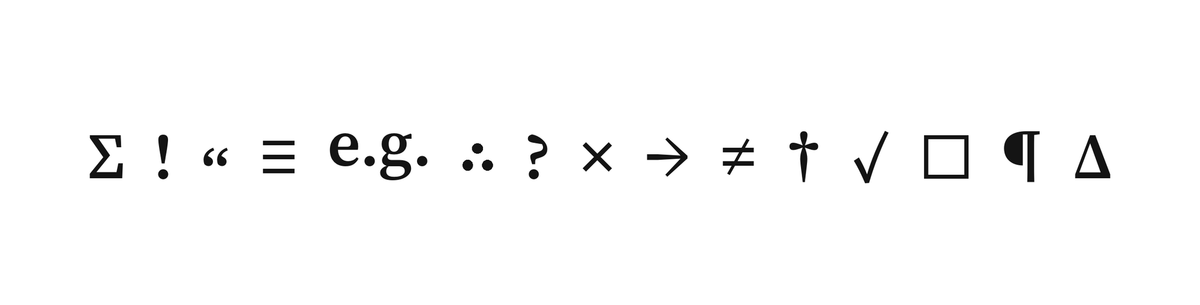
A type mark is a single character, written in the margin level with a passage’s first line, that indicates what kind of passage it is. There are fourteen of them (again, please forgive me). That is more than anyone learns in a sitting, so they come in four groups, according to what they record: what the author is doing, what the reader is feeling, what the passage is connected to, and what the reader now has to go and do.
The characters were chosen for two properties and no others. Each must be writable in one stroke or two, and each must be tellable from the rest at a glance, so that a margin can be read top to bottom without stopping. Several are borrowed from logic and mathematics, which solved the problem of a one-character “therefore” and a one-character “is defined as” a long time ago and have not been thanked enough.
Marks for what the author is doing
The first and most frequent is the key claim, marked with an exclamation point, !. A key claim is a central assertion of the argument, one you would cite if asked what the chapter argues. The test for the ! is whether the sentence could stand alone as a one-line statement of the author’s position on the point at hand. In the pages of Karl Barth I use below, “the God of the Gospel is no lonely God, self-sufficient and self-contained” is a key claim because it says what its section is for in a single breath. A sentence that restates a claim already marked, or that illustrates it, does not get a second exclamation point. One is a signal, but five are wallpaper.
The second is the quotation, marked with an opening quotation mark, “. It says that the wording of this passage is to be kept, and it goes where the reader expects to quote or where the formulation is the point. The quotation mark is the one type mark that a highlighter regularly replaces, for a reason given under color: the highlighter shows exactly how much would be transcribed, and a character in the margin cannot.
The third is the definition, marked with the identity sign, ≡. A definition is a passage in which the author fixes the sense of a term, and the mark moves with the term, written in the margin after the symbol (≡ aletheia), with the word in the text underlined. Definitions are marked even when the reader already knows the term. Especially then, in fact, because an author’s sense of a familiar word is usually narrower or stranger than the dictionary’s, and the definition entry on the sheet is what allows you to use the word in the author’s sense without being caught using it in your own.
The fourth is evidence, marked e.g. Evidence is a case, an example, a text, or a datum that the author brings forward in support of a claim. The mark indicates that the passage is doing support-work. What it is supposed to support, and whether it manages to, are questions for the sheet. In the sort of argued text theologians and philosophers write, examples are rare enough that their arrival is news. In a work of history examples are the whole substance, and the mark is used constantly; I come back to this.
The fifth is the step, marked with the “therefore” sign, ∴. This is the type mark that keeps company with the bracket. Where the bracket records how much text a unit occupies, the ∴ records the point inside it at which the inference is actually drawn, and it takes the unit’s numeral: ∴3 is the inference of the third unit. The mark goes where the inference happens, which is often a sentence that begins “therefore” or “hence” and is sometimes a sentence with no signal at all, because authors do not always announce their steps and the interesting ones frequently do not. Sometimes you can see a step being taken that the author has not marked as one. The mark is still ∴; that the step is your reconstruction and not the author’s gets recorded on the sheet, in a way explained below.
The sixth is Scripture, marked with a dagger, †. It records a biblical text cited or appealed to, with the reference written in the margin if the text does not give it. It is used for any scriptural citation, whether the author expounds the passage or merely waves at it; that distinction, which decides a great deal in theological argument, is made on the sheet. In texts that are not theological the dagger sits idle. It is the one mark in the set that belongs to a particular discipline, and a reader in another one is free to retire it or give it a new job.
Marks for what the reader is feeling
The next three marks record something about the reader, and they are the three most reliably confused with one another. Slowly, then.
The question, ?, records that a passage is unclear, or that the reader has an objection which has not yet found its words. It is the mark of uncertainty and it claims nothing except that something here is unclear to this reader on this day. A question may be resolved by rereading, in which case it is struck at harvest, or the difficulty may turn out to live in the argument, in which case it becomes the next mark. Otherwise, it stays a question on the sheet, with a note of what would answer it.
The flaw, ×, records that the argument fails on its own terms at this point: a conclusion that does not follow, a claim with nothing under it, a term used in two senses, an example that does not show what it is said to show, etc. It is the mark of a charge, and a charge is a serious thing to lay. It goes only where the reader could say what has gone wrong. If you cannot say, you have a question, and the honest mark is ?. The distinction is important because the two produce different entries on the sheet, and because a charge that cannot be stated is an uneasiness, which is worth recording and should be recorded as what it is.
The reader’s own view, Δ, records that the reader has a judgment about the passage, for or against. It is the mark of position. It commits the reader to writing that position out at harvest, and in the text it discloses only that a judgment is owed in the notes. Δ is the mark I reach for most often when I catch a marginal note trying to form. A marginal note is nearly always a judgment trying to get written in the wrong place.
The three are told apart by what the reader is prepared to claim. A question claims nothing. A flaw claims that the argument fails and that the reader can say how, whereas a view claims only that the reader has a position, which might be agreement, disagreement, or a qualification, and which is a different animal from a charge that the argument fails. Take a constructed sentence: “Since every tradition is a product of history, no tradition can claim more than historical authority.” A reader who does not know what “historical authority” is supposed to mean places ?. One who sees that the conclusion does not follow, because being a product of history does not by itself cap the kind of authority a thing can claim, places ×. A third reader, who thinks the conclusion true and the argument for it feeble, places Δ and may put × beside it. All three are reading well. They are recording different things, and at harvest each will write a different kind of entry, which is the point of having three marks instead of one.
Marks for what the passage is connected to
Two marks record a relation between the passage and something outside it.
The link, →, records a connection to a lecture or another reading, or to a sheet of one’s own. It is the one mark that takes a word as a matter of routine. A link without a target is a road to nowhere: → Tu lect, → Calvin, → p. 45. The word is the target and nothing else. What the connection actually is gets written on the sheet.
The contrast, ≠, records a point at which the author’s position parts company with another author’s. The other author’s name goes in the margin. The mark is used both where the author draws the contrast and where the reader does, and the sheet will say which, because the two are worth very different things.
Marks for what the reader has to do
The last three record a task, and they are the marks that keep the sheet from becoming a purely contemplative document.
The discussion mark, ✓, records a matter to raise in a class or seminar, or to chase down before the next reading session. It goes beside passages the reader wants to ask about and passages that are plainly going to be fought over.
The look-up mark, an open box ☐, records an item to be found. This can be a cited work, a term in another language, a name, or a reference. The box gets ticked on the sheet when the item has been looked up. One can add the definition or additional context to the note-sheet, but not in the margin of the text.
The writing mark, a pilcrow ¶, records a phrase or an idea that could go into something the reader is writing. The mark indicates only that the passage has that use. The sheet says for what.
That is the whole set: fourteen characters in four groups, each with one meaning. A reader who has followed this far will have noticed that several of the marks come in pairs that differ by who is speaking. ! and Δ are such a pair, the author’s claim and the reader’s judgment, and so are ∴ and ×, the inference the author draws and the inference that fails to arrive. The pairing is deliberate. The sheet must keep the author’s statements and the reader’s statements apart, because a sheet on which the two are mixed cannot be cited from. A later reader, who will be you, will not know whose sentence is being quoted, and the paper that results will attribute to Barth something you said in the margin on a Tuesday.
Combining marks, and the one-word rule
A passage may carry a structural mark, a type mark, or both. Where it has both, the type mark sits at the head, level with the first line. Where a passage carries two type marks, as a sentence that is both a key claim and a quotation does, both are written with a space between them: ! “. Two is the practical limit. A passage that seems to want three type marks is nearly always two passages wearing one coat.
The one-word rule, stated earlier as a consequence of the division of labor, can now be made exact. Three marks take a word: ≡ takes the term and → its target, while ≠ takes the other author’s name. No other mark takes anything. A reader who wants to write “but compare p. 45, where he says the opposite” writes → 45 in the margin and the sentence on the sheet. For the first few weeks this will feel like a loss, and it is worth saying plainly that it is a deferral. The sentence gets written, at harvest, with the whole argument in view, and it gets written somewhere it can be found again, which the margin of page 12 is not.
A marked page, read down its outer margin, then looks like this. The lines and brackets show where the passages are and how the argument divides into steps. The characters at their heads say what kinds of passage they are. A reader who knows the fourteen characters can take in the structure of a page in a few seconds without reading a word of the text, and that is precisely the skill the harvest depends on. Here is a short constructed paragraph with what its margin would carry, set out as a table because a web page has no margin worth writing in. The passage is imagined on a right-hand page, so the marks fall on the right.
| Text | Margin |
|---|---|
| The church does not possess the Word; it is possessed by it. This is the whole of what is meant by the authority of Scripture, and it is why the term is so easily misunderstood. | ‖ ! ≡ authority |
| For if authority is taken in its ordinary sense, as a power exercised by one party over another, then Scripture has no authority at all, since it exercises nothing. | | ~ |
| Rather, its authority is that of a witness: it is authoritative because what it attests is true, and for no other reason. | | ∴2 |
| Calvin saw this when he refused to ground the authority of Scripture in the church’s decree. | → Calvin ☐ |
The first sentence is significant and a claim, and it fixes a term, so it carries the double line, the exclamation point, and ≡ with the term underlined in the text. The second has a single line and a wavy underline beneath the phrase whose sense is in doubt (the plain underline in the table stands in for the wavy one). The third has a single line and is the second step. The fourth is a link to Calvin and an item to look up, since the reader is going to want the passage in the Institutes and does not have it.
Color
The highlighter is the most used and least useful instrument in most readers’ hands, and before deciding what to do with it, it is worth asking why it fails so dependably. A highlight is fast and visible, and it cannot be undone. In ordinary use it is also meaningless, because it is applied to whatever seems important at the moment, and “important” is a judgment that changes from page to page and from Tuesday to Thursday. A book highlighted on that principle is a book in which the reader’s shifting sense of what mattered has been recorded in fluorescent ink and can never be revised. Open a used textbook and you can watch it happen: the first chapter glows like a runway, and by the fifth the highlighter has been laid down in despair. The pencil marks already described say “important” in a graded and reversible way, and they can be erased on a better day.
The highlighter needs a job that the pencil cannot do, and there is exactly one. A pencil line says that the content of a passage is to be kept. A highlighter can say that the wording is to be kept, and it can say exactly which words, which no character in the margin can. A highlight, in this system, means that these particular words are to be transcribed. It is therefore short, a sentence or two, and it always lies inside a passage that also carries a pencil mark, since a sentence worth transcribing belongs to a passage worth reviewing.
Two colors, each with one fixed meaning, matched to the two type marks that concern wording.
Yellow means quotation. A yellow highlight is “ with the extent shown. At harvest, each yellow highlight is either transcribed onto the sheet or, if on rereading the sentence turns out to be less than it seemed, struck through with a pencil line. There is no third fate.
Blue, or green, means definition. A blue highlight marks the sentence in which a term gets fixed and is ≡ together with the underlined term. At harvest it becomes a definition entry, in the author’s words. The choice between blue and green is made once and never revisited.
Importance gets no color. This is the rule that takes longest to sink in, because it runs against a habit older than most of our reading. When you feel the pull to highlight a passage because it matters, reach for the pencil and draw a double line, which says the same thing and can be taken back.
A third color may be admitted for evidence, in a text where examples are thick on the ground and need to be found fast. Works of history are the main case, and I return to it. A book with four highlighter colors in it is a book in which the reader has stopped deciding and started decorating.
When the book cannot be written in
Library copies and borrowed books, and editions one does not wish to deface, all present the same problem, and the answer is the same: the mark rides on an adhesive flag, the small removable tab that comes in packs of five colors. The flag goes at the line where the passage begins and sticks out past the fore-edge, so that a closed book shows where its marks are. The type mark is written on the tab in pen. The same fourteen characters are used, and the color of the flag is a convenience, useful for finding flags of one kind in a hurry: in a five-color pack, yellow for “, pink for !, blue for → and ≠, green for ?, ×, and Δ, orange for ✓ and ☐.
The structural marks have no exact flag equivalent, and the approximation is this. A bracketed unit gets a flag at its beginning and one at its end, each carrying the bracket and its numeral. Single and double lines are not reproduced; the type mark on the flag does their work. A flag with no character on it stands for a single line. Anything that needs words goes on a full-size adhesive note stuck in the margin and is limited to a phrase, exactly as in a marked book. The flags do not suspend the one-word rule.
Harvesting a flagged book has one pleasing feature over harvesting a marked one. Once an entry is written, the flag comes out, so the flags still standing are the passages not yet dealt with, and a book with no flags left is by definition a harvested book. Because the flags will be gone, the two records that would otherwise live inside the covers, described under harvesting, are kept on a sheet filed with the notes.
Digital texts
Most of this transfers to a PDF with a change of instrument, and I will be brief, because the principle does not change and the software will. A PDF reader’s highlight tool does what the highlighter does, in the same two colors. Its underline tool does what pencil underlining does. Its comment tool, anchored to the first line of a passage, carries the type mark: the comment’s text is the character and, where required, the one word. The extent of a passage, which the marginal line records on paper, is recorded either by a highlight in a third, neutral color kept for that purpose or by anchoring the comment to a selection that covers the passage. A bracket is a comment reading “[3” at the start of the unit and “3]” at its end.
At harvest, a reader that lists its annotations in a sidebar makes the procedure quicker than it is on paper, since one works down a list instead of turning pages, and marking an annotation resolved plays the part of the circle (to be discussed). Then comes the temptation peculiar to digital texts, which is to export the annotations and call the export a sheet. It is a list of passages. A sheet is the set of typed statements about those passages that the reader writes at harvest, and no export button produces it, however many export buttons get pressed.
One caution about locators. The page number of a PDF as the software counts it is rarely the number printed on the page, and the printed number is the one that will be cited. For a scan of a book the printed number is used, and for a journal article the journal’s pagination. An unpaginated document takes a paragraph or section number, noted as such so that nobody later mistakes it for a page.
A page, marked
The example I have been drawing on is the first chapter of Karl Barth’s Evangelical Theology: An Introduction, the lectures with which Barth closed his teaching at Basel in 1962 and then carried, in part, on his one visit to the United States, in Grover Foley’s English.[4] The chapter is called “The Word,” and in it Barth sets out, in a series of numbered “places,” what the object of theology is. My pages are the third and fourth places, pages 9 to 12 in the Eerdmans edition. A reader who is not a theologian needs to know only that Barth is saying what theology is about, insisting that it is about God as God acts in history, and then, in the fourth place, asking whether such a God is remote from human beings or with them. The passage is short and dense, and it argues from its first sentence to its last, which makes it a fair test of the marks and a stern one.
The figure shows page 9 as I marked it. It is a right-hand page, so the margin is on the right.
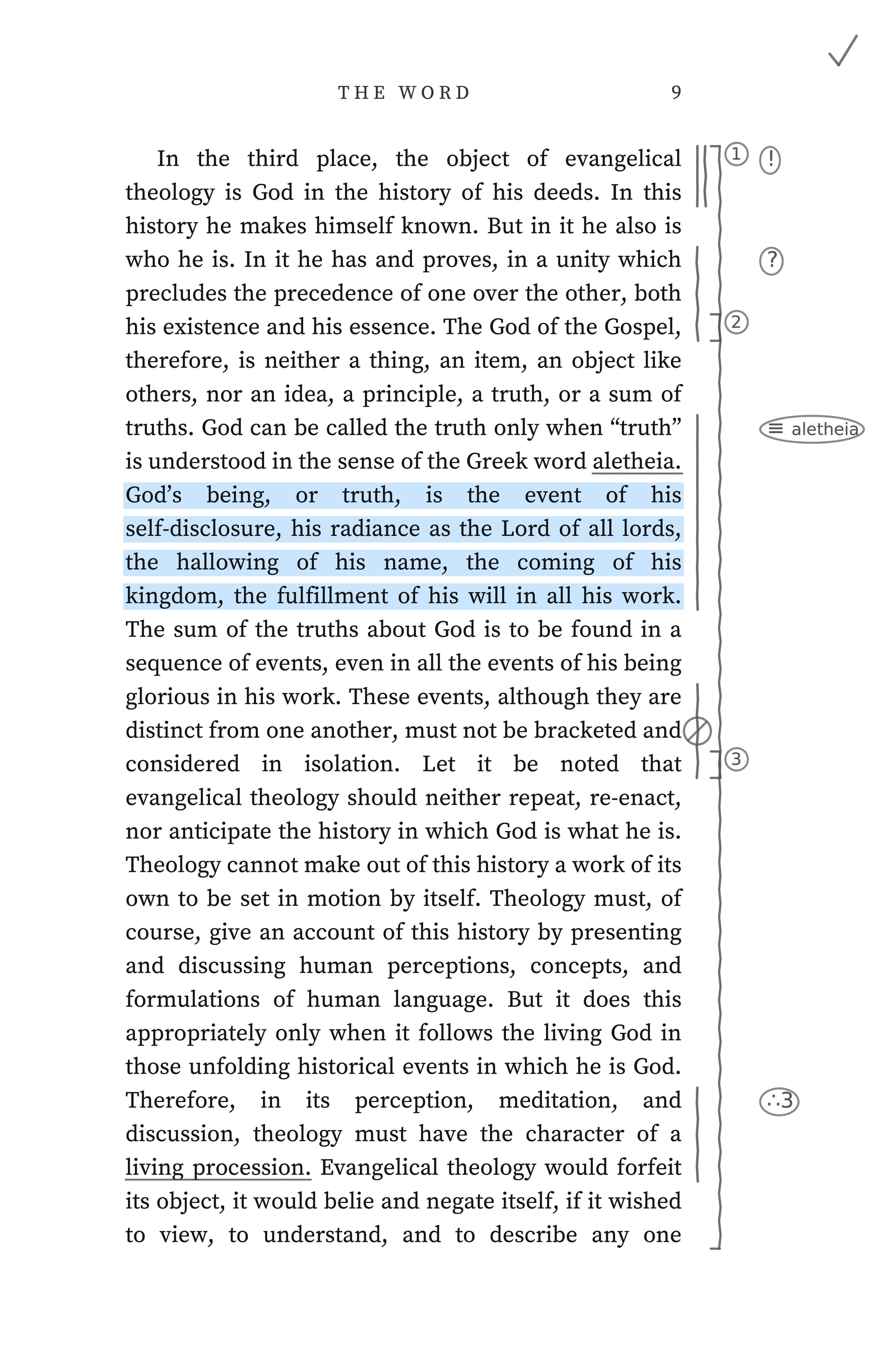
Take the marks in the order a reader meets them.
The opening sentence, “In the third place, the object of evangelical theology is God in the history of his deeds,” received a double line and a !. The double line because everything else in the section depends on this sentence; the exclamation point because it is a claim, and the one that states the section’s position. A bracket numbered 1 covers this sentence and the three that follow it, through “both his existence and his essence,” because together they make the first step: the object is God in God’s history, and in that history God’s existence and essence come together or not at all. Inside the bracket, the phrase “a unity which precludes the precedence of one over the other” got a single line and a ?. On a first reading it was not clear whether the unity in question is that of existence and essence or that of God’s being known and God’s being. The question was recorded in one character and the reading went on.
Bracket 2 begins at “The God of the Gospel, therefore” and runs to “considered in isolation.” This is the second step: from the first, it follows that God is not a thing, an idea, or a sum of truths. Inside it, the sentence beginning “God’s being, or truth, is the event of his self-disclosure” received a blue highlight and, in the margin, ≡ aletheia, with the Greek word underlined in the text, because here Barth fixes the sense in which “truth” may be said of God at all. Two sentences later, “These events, although they are distinct from one another, must not be bracketed and considered in isolation” got a single line. At harvest, it turned out to add nothing to the entry for the second step, and it was struck. I mention it because that is the ordinary fate of a single line, and a reader who is not striking a fair number of them at harvest is not placing enough.
Bracket 3 begins at “Let it be noted” and runs over the page to the end of the section. Near the foot of page 9, at “Therefore, in its perception, meditation, and discussion, theology must have the character of a living procession,” a ∴3 was placed, because this is the inference the section has been walking toward, and “living procession” was underlined as the term in which Barth lands it.
Nothing on the page is marked ¶ or ✓, and there is no Δ. The page is expository, and a reader who is placing judgments on an expository page is usually judging the author for not having got to the point yet. The judgments were kept for the fourth place, on the following pages, where Barth characterizes Schleiermacher’s God in a sentence beginning “By definition,” and where the margin fills up: ≠ Schl., a ×, a wavy line under the first two words, and a ✓ a few lines below.
The proportions on the four pages, for readers who want something to calibrate against: two double lines, seven numbered brackets, seventeen single lines, ten underlined terms, two wavy underlines, four yellow and four blue highlights, twenty-six type marks. Single lines outnumber double lines eight to one. About a quarter of the single lines carry no type mark, having been placed only so that the passage would be reread. A reader whose margins show double lines everywhere and a character beside every line is marking for emphasis, and the harvest will take longer than the reading did.
The sheet
Everything so far has been about the text, and the text’s residue is now a set of marks, each of them fast and each with one meaning, saying where a passage is and what kind of thing it is. Not one of them says what the passage says. That is the sheet’s job, and the sheet is where a reading stops being an experience and becomes something a scholar can use.
What a sheet is
A sheet is a loose-leaf page, filed in a binder for the course or the project in question. Loose-leaf beats a bound notebook for two reasons. A sheet for a reading can be filed next to the sheets for a lecture and a discussion of the same week, so the binder keeps the course in order. And a sheet can be pulled out and laid beside the book, or beside another sheet, when two readings are being compared, which a bound notebook resists with its whole spine. Ruled paper with a left margin is best, since the symbol goes in the margin and the rest of the entry follows on the line.
Every sheet has a header of two lines, written before reading begins. The first line gives the sheet’s place in the binder: the week, the day, the course, the kind of sheet, and the sheet’s number in its set. The second identifies the reading: author, title, the pages assigned, and the session they are assigned for. In practice:
Wk 3 · We 23 Sep · TH · reading · sheet 1 of 2
Barth, Evangelical Theology, chs. 1–2 (pp. 3–33) · for discussion Fr 25 Sep
The first line is what lets a sheet that has come loose find its way back. The second is what lets the sheet be cited from without the book, because the edition can be recovered from the course reading list; if the edition in hand is a different one, that goes at the end of the line, and it goes there now, because the difference will be invisible in six months.
Below the header come the entries, in the order of the pages they refer to, and below the entries, at the very end, the summary. The sheet has three columns, unruled: the symbol at the margin, then the locator, then the note. A note that runs past a line is carried on with a hanging indent, so that the column of symbols stays clean and the sheet can be scanned by symbol, which is how it will mostly be read.
The parts of an entry
An entry has three parts, and each has rules.
The symbol is written exactly as it was in the book. The same fourteen type marks are used, plus one that exists only on the sheet, the summary, introduced below. Two modifications are permitted. A symbol may be doubled for emphasis. And a symbol may be followed by Δ to show that the entry records the reader’s contribution and not the author’s. Both are explained in their place.
The locator is the author’s page number in the edition being read. It is written for every entry, with one exception: a Δ entry that refers to the reading as a whole, and to no passage in particular, takes a dash. The conventions for the ordinary cases are these. A page is written as a number, 9. A range as 9–11. A footnote as 9n4, note 4 on page 9. A numbered section, where pagination wanders between editions, as §2.1. Front matter as xii. A multi-volume work takes the volume before the page, 2:345. A work cited by a standard division rather than by page, Calvin’s Institutes for instance, takes the division, 3.2.7, with the page of the edition in parentheses if the edition will be cited. An archival document takes the citation form of the archive, usually the fonds, carton, dossier, and folio, abbreviated consistently on the sheet and written out once in full in the header.
The note is a fragment, unless it is a quotation. It uses the reader’s abbreviations consistently (B. for Barth, Schl. for Schleiermacher) and separates clauses with semicolons. It is as short as it can be while still making sense to the reader in a month. The test is whether, rereading the note without the book, you would know what you meant and could find the passage from the locator. If either fails, the note was too clever.
One rule about notes is absolute, and it is the rule that makes the sheet safe to build on. The author’s words appear in a note only inside quotation marks. This holds for every kind of entry, and it is easiest to break in the definition entry, where the author’s phrasing is right there asking to be borrowed, and in the key-claim entry, where a paraphrase drifts into copying one clause at a time. A phrase carried from a sheet into a paper without quotation marks is a phrase carried from the author without acknowledgment, and nobody sets out to do that. It happens on the sheet, months earlier, in the form of a pair of quotation marks that seemed unnecessary at the time. The sheet is the point at which that error is either prevented or made inevitable, and there is no third point.
The entries, one by one
Each symbol has a characteristic form of note, and the form is part of what the symbol means. What follows gives the form and an example of each, taken from the sheet I made for the Barth pages. Where an example has been shortened, the omission is marked.
The key claim entry is a paraphrase of a central claim, in the reader’s words, compressed. It should be citable as a paraphrase: the words “Barth holds that,” followed by the entry, should make a true sentence, and if they make a false one the entry is wrong.
! 10 the God of the Gospel is no lonely God, self-sufficient and self-contained; not “absolute”; free to be the God of man
The quotation entry is a transcription, in quotation marks, with the page. Nothing is changed. An omission is marked with an ellipsis and an insertion with square brackets. An entry without the “ symbol is never a quotation, however closely it follows the text, and this is a rule about the sheet and not about the reader’s memory, which is exactly why it works.
“ 10 “Instead, theology must describe the dynamic interrelationships which make this procession comparable to a bird in flight, in contrast to a caged bird.”
The definition entry gives the term, a colon, and the definition, in the author’s words where the wording matters and otherwise in the reader’s. Where the author’s words are used, they are in quotation marks. The entry indicates the sense in which the reader may use the term when writing about this author.
≡ 11 dysangelion: the “bad news” of “a divinity without humanity,” a God who confronts man simply as exalted, distant, and strange; coined as the antonym of euangelion
The evidence entry gives the example and what it is meant to establish. Where it does not establish it, a flaw entry follows on the next line, and the two entries together are worth more than either.
e.g. 11 the inhuman god “embodied in deified ‘progress,’ or even more likely by the progressive man”: meant to show that the abstract “absolute” god has a modern secular form; the only concrete instance in the passage, and it is not argued
The step entry states the step as an inference: the claim, and briefly what it follows from. It carries the numeral of its bracket. The chain of step entries, read in order, should reconstruct the argument without the book. If it does not, either the chain or the argument is broken.
∴3 9–10 therefore theology, which can only follow God in these events, must itself have the character of a living procession; it may neither repeat, re-enact, nor anticipate the history, only give an account of it by following it
The question entry gives the question and what would resolve it. The second part is required. A question without it is a record of confusion, and confusion, once recorded, has a way of looking like a point.
? 9 “a unity which precludes the precedence of one over the other”: of existence and essence, or of God’s being known and God’s being? … settled by whether “history” here = the economy or God’s own life (cf. ∴4, p. 11)
The flaw entry states the charge specifically enough to be answered: what is missing or what does not follow, or which term has shifted in sense. Where possible it says what would answer it. The example shows why that last part earns its keep. In writing out what would answer the charge, the reader recalled a passage that might, and the charge was qualified on the sheet instead of marching into a paper and getting shot there.
× 11 “By definition”: the claim about Schleiermacher is asserted, not shown; no text is cited. Answerable from Christian Faith §85, where Schl. says that attributing mercy to God belongs to preaching and poetry rather than to dogmatics; if so, B.’s “by definition” has a basis and the × reduces to a ☐[5]
The link entry gives the target in full, a lecture by its date or a reading by author and page, and a sheet by its header line, and then a phrase saying what the connection is. A link that names its target and stops is a road sign in an empty field.
→ 10 Tu lecture on second-order reflection · p. 19: B.’s “critical” = under judgment by its object (crisis), not Kantian critique
The contrast entry names the other author and states the difference, in a form that could be unfolded into a comparison.
≠ 11 Schleiermacher: “By definition, the God of Schleiermacher cannot show mercy. The God of the Gospel can and does.” B.’s reason is implied only
The Scripture entry gives the reference and the use made of it, noting whether the text is expounded or only invoked. Theologians invoke a great deal more than they expound, and the sheet is where one keeps count.
† 11 Isa 57:15, cited for the coincidence of “the high and holy place” with “him who is of a contrite and humble spirit”; invoked as warrant, not expounded
The discussion entry phrases the matter as the question that will actually be asked, in words that can be read aloud from the sheet without editing.
✓ 11 raise: is God’s freedom for man grounded in the Trinity or only paralleled to it?
The look-up entry says what is to be found and where to look. The box is ticked when the item is found and the source added.
☐ 12 locate the Nietzsche line (Also sprach Zarathustra, Vorrede 3) and check which rendering Foley follows
The writing entry gives the phrase or idea and the piece it is for.
¶ 12 “the most thankful and happy science”: closing line for a sermon on the vocation to theology; pairs with charis/eucharistia
The reader’s own view entry gives the judgment in the reader’s words, and marks it provisional where it is, which is more often than pride would like. A view of the reading as a whole takes a dash for its locator.
Δ — the “critical science” of p. 10 and the “thankful and happy science” of p. 12 are the same claim from two sides; the passage does not say so; provisional
The summary
One entry exists only on the sheet. The summary, marked with a capital sigma, Σ, states the thesis of the chapter, or of the argument as a whole, in one sentence or at most two. It is written last, after everything else, because it depends on everything else, and it goes at the foot of the sheet. For a long chapter with numbered sections, section summaries go beneath it as Σ §3, Σ §4, and so on.
Σ 9–12 The object of evangelical theology is God in the history of God’s deeds, in which God both makes Godself known and is who God is, and who, being no “absolute” God, is free to be God with and for human beings. Theology must therefore move with its object rather than fix it, is critical because it stands under its object’s judgment, and is better called theoanthropology: a thankful science whose object is Immanuel.
The summary is the most compressed entry on the sheet and, indeed, the hardest to write, and any reader who finds it easy should suspect the summary. The test of a good one is whether it could be read aloud in answer to “what does the chapter argue?” and be both true, in that the author would recognize it, and complete, in that nothing the chapter depends on has been left aside.
The summary is then checked against the chain of step entries, and this check is the reason the brackets were numbered. Each step should answer to a clause or a movement of the summary, and each clause of the summary should have a step beneath it. Where a step has no counterpart in the summary, the summary is incomplete and is revised. Where the summary contains a clause that no step supports, one of two things is true. Either you have missed a step the author makes, in which case you find the passage and add the entry. Or the author has not made it, in which case there is a hole in the argument, and the hole is recorded as a question or a flaw. This is the moment at which a reader most often discovers that an argument does not do what it seemed to be doing while it was being read, and the discovery is worth the five to ten minutes every time.
A summary is a paraphrase in the reader’s words. It contains no quotation and no judgment. The first would make it a quotation entry, the second a view, and a reader who notices the summary turning into an evaluation has two entries to write and is trying to get away with one.
Emphasis and attribution
Two modifications of the symbols were promised above.
A doubled symbol indicates emphasis, of a specific kind and no other. !! marks the thesis itself, as distinct from the several key claims that serve it; a chapter has one !! and may have several !. ?? marks the objection the chapter’s argument would not survive, the question that, answered against the author, brings the whole thing down, and ““ the one quotation the reader would keep if allowed only one. The doubled symbol is never used to mean “very important” in a general way. It has the meanings given, and inflation is the enemy here, as it is everywhere.
A symbol followed by Δ, which I will call the Δ suffix, indicates that the entry records the reader’s contribution and not the author’s. →Δ is a connection the reader makes that the author does not, and ≠Δ a contrast the reader draws; ∴Δ is a step the reader thinks the argument needs and the author declined to supply. The suffix keeps the reader’s reconstructions from being mistaken, later, for the author’s own moves. That mistake is easy to make once the passage has faded, and it is the kind of error that, carried into a paper, attributes to an author an argument the author never made and would not thank you for. An entry with the suffix is still typed by its first symbol and turns up among the → or ≠ or ∴ entries when the sheet is scanned.
The sheet for the Barth pages
The sheet I made for pages 9 to 12 holds thirty-three entries, followed by the summary and two section summaries. It is reproduced in full at the point where I describe the harvest. The harvest is what produced it, and a sheet is easier to read once you know how each line got there. Its proportions can be given now: four key claims, four quotations, four definitions, seven steps, one question, two flaws, one link, two contrasts, one Scripture, one discussion, one look-up, two writing entries, two views, and one piece of evidence. The seven steps, read in order, give the argument of the passage in seven sentences. The summary squeezes them into two.
Harvesting
The word is agricultural. The marks in the book are a crop left standing in the field. The harvest gathers it, and what is gathered is stored, well, somewhere else, in a form that will keep. The image is important, as it implies the two features that are crucial and that readers most want to skip: the harvest happens after the growing, and it happens once.
When
Harvesting takes place at the end of a reading session, or at the latest before the next session on the same book. In every case, it happens before the class or meeting for which the reading was done. The end of the session is the ideal. The marks are fresh and the argument is still in the room, and the harvest then takes roughly a third to a half of the time the reading took. Before the next session is the limit. A second session of reading in a book with unharvested marks from the first produces a book in which nobody, including you, can tell which marks belong to which session, and the harvest of both decays into a rereading. The class (or whatever you want) is the deadline because the sheet is what you bring into the room. A reader who arrives with a marked book and no sheet has brought a field and no bread.
A harvest can be split across two sittings if the reading was long, on one condition: the pages done in the first sitting are marked as done, so the second sitting starts at the first page that is not. The mark for “done” has been waiting since the section on extent, and here it is (finally).
The circle and the tick
The sixth structural mark is the circle. It is drawn at harvest around any mark whose entry has been written. It means that the mark has been dealt with. It goes around the type mark where there is one, and around the numeral of a bracket. A single line with no type mark is circled at its midpoint. When every mark on a page has been circled, a tick goes in the page’s top outer corner, and it means that the page is finished and need never be looked at again, at least not for this purpose.
The circle and the tick are tiny, and they are what make the state of a book readable at a glance. An uncircled mark is a passage not yet transferred, and a page without a tick has not been fully harvested. A book in which every marked page is ticked has been harvested completely, and the reader knows this from the book alone, without finding the sheet. Readers who use flags get the same thing free, since a harvested flag is a removed flag.
The endpapers
Two records are kept inside the covers, and they are set up before the book is read for the first time, which takes about a minute and repays it several hundredfold.
Inside the front cover is the harvest log: one line per harvest, giving the date and the pages harvested and naming the sheet the entries went to. “24 Sep · pp. 3–33 · TH Wk 3 sheets 1–2.” A book read over several weeks accumulates several lines, and the log is the first thing to consult when the book is reopened a year later, because it says which sheets hold whatever was taken. If you prefer not to write on the inside front cover of the book, you can use a large Post-it note or index card.
Inside the back cover is the index: one line per symbol, listing the pages on which the symbol occurs and, for the symbols that take a word in the margin, that word too. “≡ 9 aletheia, 10 absolute, 11 dysangelion, 12 theoanthropology.” The index is built at harvest, when the page numbers are already on the sheet, and it lets the reader find every definition in the book in a minute, without the sheet and from wherever the book happens to be.
Between them the two endpapers turn the book into a record of its own use. A secondhand buyer who found them would indeed learn a good deal more than the margins could ever tell, including the one thing the margins never say, which is what became of the marks.
The procedure
The harvest goes in eight steps. I give the reason for each, since the reasons are what make the steps stick when the deadline is close and the temptation to improvise is strong.
First, the sheet is opened and, if the reading has run to a second sheet, the second is headed with the next number in the set. The harvest date goes at the end of the header’s second line.
Second, the first marked page is found. In a book this is done by riffling the fore-edge for pencil in the margin; in a flagged book, by the flags. Unmarked pages are passed over without a glance. The harvest rereads the marked passages only. It is not a second reading of the chapter, and readers who let it become one will stop harvesting within a month. I promise you that.
Third, at each mark, the passage is reread and a decision is made: whether the mark warrants an entry, and if so of what kind. For a type mark the kind is given, and the only decision is whether to write it. For a structural mark or a highlight the kind must be decided, according to the correspondences set out below. The decisions are made in page order, so the entries come out in page order and the sheet can later be walked alongside the book.
Fourth, the entry is written, or the mark is struck. Striking is a short pencil stroke through the mark, and it means that the passage was reconsidered and found wanting. A struck mark is never reconsidered on a later pass. That is what the stroke is for.
Fifth, the mark is circled, whether it produced an entry or was struck. Circled means dealt with and dealt with includes dismissed.
Sixth, when every mark on the page is circled, the corner is ticked.
Seventh, when the last marked page of the chapter is ticked, the summary is written at the foot of the entries, and the step entries are read in order against it in the way described above. Section summaries are written if the chapter has sections. Any daylight between the summary and the chain becomes a question or flaw entry, added with the locator of the passage concerned.
Eighth, the index is updated with the page numbers of the new entries, and the harvest goes into the log. The log and the index now agree with the sheet header, and the harvest is complete.
The decisions
Type marks carry over without a decision. Structural marks and highlights each have several possible fates, and here is where the reader’s judgment at harvest is crucial. The possibilities, with what actually happened to each in the Barth pages:
A single line becomes one of four things. Most often it contributes a phrase to the summary, or to a step entry being written from the bracket the line sits in and gets no entry of its own. The line beside “Again and again it must distinguish between what God made happen and will make happen” went into the section summary this way and was content there. Sometimes a line is found to warrant nothing and is struck; the line beside “These events, although they are distinct from one another” was struck, because the second step entry already said everything it says. Occasionally, on rereading, a single line turns out to mark a key claim, and it is promoted: a ! goes at its head in the text and a key-claim entry goes on the sheet. The line beside “He is man’s God not only as Lord but also as father, brother, friend” was promoted, because the clause that completes it, “a confirmation and display of his divine essence itself,” makes God’s being for humanity a matter of God’s essence, and the rest of the section leans on that without saying so. The fourth possibility is that the line becomes a quotation entry, when rereading shows that the wording itself was what was significant. This is rare because such passages usually get highlighted at the time.
A double line always becomes an entry, and the only decision is whether the entry is a key claim, a quotation, or both. The double line at “He is exalted precisely in his lowliness. And so his inevitable No is enclosed in his primary Yes to man” became both, because the claim is central and the sentence is one the reader will want in the author’s own words.
A bracket becomes a numbered step entry. If, in writing the entry, the reader discovers that the bracket holds two steps, it is divided and the numerals after it shuffle down. If two brackets prove to be one step, they merge. This is the redrawing mentioned earlier, and it is normal, and a reader whose brackets never move at harvest is not really looking at them.
An underlined term becomes a definition entry if the author fixes its sense in the passage, and otherwise nothing. Of the ten terms underlined in the Barth pages, four became definition entries. The other six turn up inside other entries, since Barth uses them without stopping to define them, which is his privilege but our problem.
A wavy underline becomes a flaw entry if the reader can now say what is wrong with the wording, and a question entry if not. The wavy line under “By definition” became a flaw because the problem could be stated, i.e., a necessity is asserted without a text. In writing what would answer it, the reader remembered the passage in Schleiermacher that might, and the entry records that, a little ruefully. The wavy line under “the gods of other theologies” also became a flaw, on the ground that the plural asserts, without argument, that rival theologies have a different object, which is a large thing to settle with a plural.
A yellow highlight is transcribed as a quotation entry or struck. There is no third outcome. All four in the Barth pages were transcribed.
A blue highlight becomes a definition entry, in the author’s words. All four did.
A page, harvested
The figure shows page 11 after harvest.
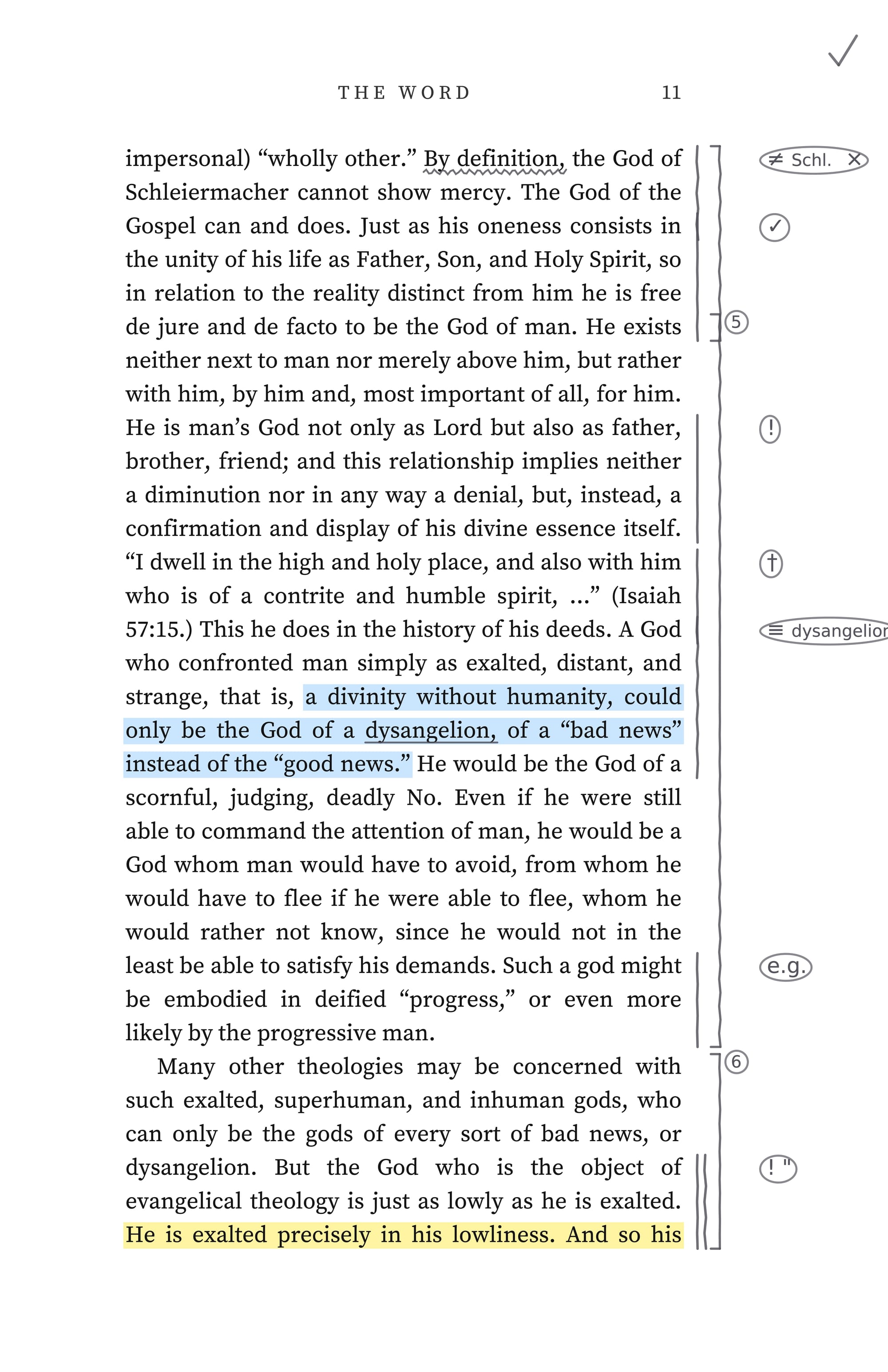
Every type mark and every bracket numeral is circled. The exclamation point beside the ninth line is new, added when the single line there was promoted. The tick in the corner says the page is done. A reader opening the book here knows at once that the page has been dealt with, and finds in the log at the front the date and the sheet, and the sheet is where the thinking went.
The sheet, complete
Here is the sheet that the harvest of the four pages produced. The entries are in page order; the summary and the two section summaries come at the end, as they do on paper. The harvest record beneath them, listing what was struck and what was reclassified, is optional. I include it because in the first weeks of using the system it is the fastest way to see how you are using the single line, and most people are using it too much.
| Mark | Page | Entry |
|---|---|---|
| ! | 9 | object of evangelical theology = God in the history of his deeds; in that history he makes himself known and is who he is; existence and essence given together |
| ? | 9 | “a unity which precludes the precedence of one over the other”: of existence and essence, or of God’s being known and God’s being? the sentence runs the epistemic and the ontological into one “history”; settled by whether “history” here = the economy or God’s own life (cf. ∴4, p. 11) |
| ≡ | 9 | truth (aletheia): God’s being, or truth, “is the event of his self-disclosure, his radiance as the Lord of all lords, the hallowing of his name, the coming of his kingdom, the fulfillment of his will in all his work”; truth is an event, not a proposition or a sum of propositions |
| ∴1 | 9 | object = God in the history of his deeds, existence and essence in unity |
| ∴2 | 9 | therefore God is not a thing, an idea, or a sum of truths; the “truths about God” are a sequence of events that must not be bracketed and considered in isolation |
| ∴3 | 9–10 | therefore theology, which can only follow God in these events, must itself have the character of a living procession; it may neither repeat, re-enact, nor anticipate the history, only give an account of it by following it; it forfeits its object if it becomes static |
| “ | 10 | “Instead, theology must describe the dynamic interrelationships which make this procession comparable to a bird in flight, in contrast to a caged bird.” |
| ¶ | 10 | bird in flight / caged bird: image for a sermon or post on doctrine as movement; the second clause carries the polemic (caged = the “paralyzed and static” theology of the next sentence) |
| × | 10 | “Regardless of what the gods of other theologies may do”: the plural “gods” asserts that rival theologies have a different object; nothing in the passage argues this; the rivals are characterized (“paralyzed and static”) rather than engaged |
| “ | 10 | “evangelical theology is an eminently critical science, for it is continually exposed to judgment and never relieved of the crisis in which it is placed by its object, or, rather to say, by its living subject.” |
| → | 10 | Tu lecture on second-order reflection · p. 19: B.’s “critical” = under judgment by its object (crisis), not Kantian critique; object here becomes “living subject” |
| ! | 10 | the God of the Gospel is no lonely God, self-sufficient and self-contained; not “absolute”; free to be the God of man |
| ≡ | 10 | “absolute” (original sense): “being detached from everything that is not himself”; B. denies this of God while affirming he has no equal beside himself |
| ≠ | 11 | Schleiermacher: “By definition, the God of Schleiermacher cannot show mercy. The God of the Gospel can and does.” B.’s reason is implied only: a God who is the mere “wholly other” cannot be with or for man |
| × | 11 | “By definition”: the claim about Schleiermacher is asserted, not shown; no text is cited. Answerable from Christian Faith §85, where Schl. assigns mercy to preaching and poetry; if so, B.’s phrase has a basis and the × reduces to a ☐ |
| ✓ | 11 | raise: “Just as his oneness consists in the unity of his life as Father, Son, and Holy Spirit, so in relation to the reality distinct from him he is free de jure and de facto to be the God of man”: is God’s freedom for man grounded in the Trinity or only paralleled to it? |
| ∴4 | 10–11 | God is not absolute or self-enclosed; he has no equal but is not imprisoned by his majesty; as triune he is free to be the God of man, with him and for him |
| ! | 11 | (reclassified from a single line at harvest) God is man’s God not only as Lord but as father, brother, friend, and this is “a confirmation and display of his divine essence itself”: the “for man” belongs to the essence |
| † | 11 | Isa 57:15, cited for the coincidence of “the high and holy place” with “him who is of a contrite and humble spirit”; invoked as warrant, not expounded; the verse supplies the exalted/lowly pair that ∴6 develops |
| ≡ | 11 | dysangelion: the “bad news” of “a divinity without humanity,” a God who confronts man simply as exalted, distant, and strange; coined as the antonym of euangelion |
| ∴5 | 11 | a God without humanity would be the God of a dysangelion, of a deadly No; man could only flee him |
| e.g. | 11 | the inhuman god “embodied in deified ‘progress,’ or even more likely by the progressive man”: meant to show that the abstract “absolute” god has a modern secular form; the only concrete instance in the passage, and it is not argued |
| ! | 11–12 | the God who is the object of evangelical theology is just as lowly as he is exalted |
| “ | 11–12 | “He is exalted precisely in his lowliness. And so his inevitable No is enclosed in his primary Yes to man.” |
| ≠ | 12 | Nietzsche: man as “something that must be overcome” against B.: man as “that creature destined by God to be a conqueror” |
| ☐ | 12 | locate the Nietzsche line (Also sprach Zarathustra, Vorrede 3) and check which English rendering Foley follows |
| ∴6 | 12 | therefore “theology” understates its object: the object includes God’s free love and the answering free love of man, grace (charis) calling for gratitude (eucharistia) |
| ≡ | 12 | theoanthropology: the term that names the object of evangelical theology as God with and for man, grace calling for gratitude; explicitly distinguished from anthropotheology |
| Δ | 12 | the coinage carries the whole excerpt: theo-anthropology against anthropo-theology restates the case against Schleiermacher as a matter of word order; that B. keeps “theology” anyway concedes that the order, and not the compound, is what matters; provisional, from this passage alone |
| ∴7 | 12 | therefore evangelical theology cannot be devoted to an inhuman God (that would be legalistic theology); its object is Immanuel, God with us |
| “ | 12 | “Having this God for its object, it can be nothing else but the most thankful and happy science!” |
| ¶ | 12 | “the most thankful and happy science”: closing line for a sermon on the vocation to theology; pairs with charis/eucharistia |
| Δ | — | the “critical science” of p. 10 and the “thankful and happy science” of p. 12 are the same claim from two sides, theology judged by its object and gladdened by it; the passage does not say so; provisional |
| Σ | 9–12 | The object of evangelical theology is God in the history of God’s deeds, in which God both makes Godself known and is who God is, and who, being no “absolute” God, is free to be God with and for human beings. Theology must therefore move with its object rather than fix it, is critical because it stands under its object’s judgment, and is better called theoanthropology: a thankful science whose object is Immanuel. |
| Σ §3 | 9–10 | God is known, and is who God is, in the history of God’s deeds; truth is the event of God’s self-disclosure, not a sum of propositions; theology must therefore be a living procession and is a critical science because judged by its object. |
| Σ §4 | 10–12 | God is neither absolute nor self-enclosed and is free for human beings; a God without humanity would be the God of a dysangelion; the God of the Gospel is exalted in lowliness, God’s No enclosed in God’s Yes; theology is therefore theoanthropology, the most thankful and happy science. |
Harvest record. Log line: 23 Sep · pp. 9–12 · TH Wk 3 sheet 1. Index lines: ! 9, 10, 11, 11–12 · ≡ 9 aletheia, 10 absolute, 11 dysangelion, 12 theoanthropology · ∴ 9, 9, 9–10, 10–11, 11, 12, 12 · “ 10, 10, 11–12, 12 · × 10, 11 · ? 9 · ≠ 11 Schleiermacher, 12 Nietzsche · † 11 Isa 57:15 · ✓ 11 · e.g. 11 · ☐ 12 · ¶ 10, 12 · Δ 12. Struck at harvest: the single lines at 9 (“These events…”, absorbed into ∴2), 10 (“Theology would forfeit its object if it should cease…”, absorbed into ∴3), and 10 (“Again and again…”, absorbed into Σ §3). Reclassified: the single line at 11 (“He is man’s God…”), promoted to !.
Two things about the sheet deserve comment. The first is that both view entries are marked “provisional.” They were formed from four pages of a book, and the rest of the chapter may confirm them (or embarrass them). A view on a sheet is actually a judgment as of the harvest date, and it may indeed be revised on a later sheet with a link back to this one, which is a more honest procedure than erasing. The second is that the sheet fits on two handwritten pages. Thirty-three entries for four dense pages is close to the ceiling of what a close reading produces. Most assigned chapters will yield less, and a reader who is regularly producing more should look at the transcript problem below.
Time, and the backlog
A harvest of a close reading takes a third to a half of the reading time. Thirty pages read in an hour are harvested in twenty to thirty minutes. A critical reading, with flaw entries to state carefully, takes longer. A survey reading is harvested in minutes.
When there is less time than that, a partial harvest beats none by a wide margin. In the reduced procedure, the double lines, type marks, and highlights are harvested and the summary is written; the single lines are left uncircled. The uncircled lines stand as unfinished business, to be dealt with when time allows or struck at the next session if the summary has made them redundant. What is never skipped is the summary. A sheet without a summary cannot be reviewed from, and a sheet that cannot be reviewed from is, if anything, just a list.
The commonest way the system fails is a backlog of unharvested reading, and the failure will compound over time. The marks of two sessions mix; the argument goes out of mind; the harvest becomes a rereading; the rereading is postponed. Each step makes the next more likely. The remedy is to treat the harvest as the last part of the reading session, which it is, and to end every session with it, even badly. Where a backlog has formed anyway, the books are harvested in the order their sheets will be needed, with the reduced procedure, and each sheet’s header confesses that the harvest was late.
What the sheets are for
A sheet exists to be used later. Each later use draws on a different part of the sheet and each explains why some entry has the shape it has. A system whose forms cannot be traced back to a use is a hobby.
Writing
A paper draws on the sheets in a fixed order. The summaries of the readings involved come first in order to recover what each argued before the arguing starts. The key-claim entries supply the positions to be attributed to each author. The quotation entries supply the quotations. The flaw and view entries supply the reader’s own argument, and the contrast and link entries supply the comparisons between authors. The writing entries, if the reading was done with the paper in view, supply phrases, some of which will turn out to be good.
Each quotation and key-claim entry can be turned into a footnote without opening the book, because the entry contains the locator and the header carries the edition. The quotation entry
“ 10 “evangelical theology is an eminently critical science, for it is continually exposed to judgment and never relieved of the crisis in which it is placed by its object, or, rather to say, by its living subject.”
becomes, in Chicago notes form, on first citation:
- Karl Barth, Evangelical Theology: An Introduction, trans. Grover Foley (Eerdmans, 1979), 10.
and later:
- Barth, Evangelical Theology, 10.
A key-claim entry produces the same note, hung on a paraphrase. The bibliography entry is written from the header. Two things are checked at the point of use, and they take five seconds: that the entry carries the “ symbol, since only those are quotations, and that the locator is a page in the edition to be cited. A section number or a dash will need converting. What the sheet cannot supply is the context of a quotation, and any passage that will be discussed at length ought to be reread in the text before it is discussed. The sheet says where to look and what was found there, but it does not do the (re)looking.
Discussion
A sheet brought to a seminar is consulted in a particular order: the discussion entries first and the open questions after them, with the views last. The discussion entries are the matters the reader intends to raise, already phrased, and the open questions are what the reader hopes the room will settle. The views are the positions the reader is prepared to defend if pressed. A reader who has harvested walks in with these three lists and does not have to riffle through a book while someone else is talking, which is a small dignity and adds up.
Afterward, the sheet is annotated. A question that was answered gets the answer and the name of whoever supplied it, and a discussion entry that was raised is ticked. A view the discussion changed is followed by a second view entry, dated, with the new position, and the old one is left standing, because the record of having changed one’s mind is worth more than the appearance of never having needed to.
Comparison
When two readings are to be compared, the sheets go side by side and the contrast and link entries on each are read first—they already hold the connections that occurred to the reader at the time, when the reader was smartest about them. The summaries are then set against each other directly. Where the comparison turns on a term, the definition entries on each sheet give each author’s sense, in the author’s words and with the page, and the comparison can be written from them without a trip to the shelf. Where it turns on an argument, the two chains of step entries are laid alongside each other, and the places where one chain has a link the other lacks are usually where the paper is.
A comparison that will be written up gets a sheet of its own, headed for the paper, on which the entries are links and contrasts with the Δ suffix, pointing at the reading sheets, since the connections drawn in comparing are the reader’s and should be signed.
Review
For review, before an examination or before beginning to write, the summaries are read first, across every sheet for the course, in order. This gives the course’s argument in a page, which is a thing most students never see and most courses never state. The chains of steps come next for the readings that will be examined closely. The definition entries across the course, gathered up, are the vocabulary. The key claims are the positions. A reader reviewing from harvested sheets can reconstruct a semester in an afternoon, and that afternoon is the single largest return on all the time spent harvesting.
Filing
Sheets are filed in the course binder in the order of the header’s first line: week, then day, then kind, then number. This puts each week’s reading sheet just before its lecture and discussion sheets. A sheet is referred to from another sheet by that first line, “→ Wk 3 TH reading sheet 1,” which is the form used for links between sheets. A book is found again by its endpapers, which say which sheets hold its harvests and which pages hold what.
Other kinds of reading
The system was built around the assigned chapter of an argued book, and that is the case described so far. Most academic reading is some other kind, and in each of them the symbols stay the same; what changes is which get used and what the harvest turns out.
A primary source
Historians read sources, and a source is read for what it records more than for what it argues. The balance of the marks shifts accordingly. The symbols are more general than a theological example might suggest.
The evidence mark, a rarity in an argued text, becomes the busiest type mark in a source, because a source’s value lies in its particulars, e.g., the names, dates, figures, and incidents it contains, any of which may become a datum in the historian’s own argument. This is the case in which the third highlighter color perhaps earns its place, so that the particulars can be found on the page without reading it again. The definition mark records the source’s own terms, and above all the labels it depends on people and groups. Those labels are frequently the thing under study. A police report that calls a student association a “cell,” or a ministry memorandum that calls a set of foreign nationals “elements,” is inventing a category in the act of using it, and ≡ with the term in the margin catches the invention in flight. The quotation mark is used more freely than in a secondary text, because historical writing quotes its sources and the harvest will require the exact words.
The three marks for the reader’s response take on a source-critical sense. A flaw marks a point at which the source’s account fails on its own terms: an internal contradiction, a claim the writer could not have been in a position to know, a figure that does not add up, a date that disagrees with one given earlier in the same document, etc. A question marks a point the reader cannot yet evaluate, and a view records the reader’s judgment of the source’s reliability or purpose at that point. The link ties the document to others in the same file or to the secondary literature, and in a dossier of related documents it is the mark that does most of the work, since a historian’s argument is so often built out of the relations between papers that were never meant to be read together. The Scripture mark has nothing to do unless the source is theological, in which case it has a great deal.
The locator follows the citation form of the archive, including the fonds, the carton, the dossier, the folio, in whatever abbreviation the reader uses in footnotes. The summary of a source is a different kind of statement from the summary of an argument. It states the source’s character, who produced it, for whom, when, and what it records, in a sentence, which is (actually) harder than it sounds! Step entries are usually absent, because a source does not argue, though an official report sometimes does, and then they apply, and the report is usually more interesting for it.
A journal article
An article is a short book and is treated as one. On screen it takes the digital marks; on paper, the pencil. The locator is the journal’s pagination. Because an article makes one argument, the chain of steps is short, often three or four, and the summary is a sentence. The abstract is no substitute for the summary. The summary is written by the reader without looking at the abstract, and the two are then compared, and the gap between what the abstract promises and what the argument delivers is a reliable question entry and, in some fields, a reliable flaw.
An article read for a literature review gets a survey reading, described below, and several such articles may share a sheet, one summary each. That sheet becomes the annotated bibliography the review is written from, and it will be the only part of the review that gets written without complaint.
A commentary
In a biblical commentary, the text under discussion is Scripture, and the dagger changes jobs. It marks the points at which the commentator states a reading of the verse in hand, so that for each verse the reader can find what the commentator takes it to mean; the verse goes in the margin. The definition mark records lexical and grammatical decisions, the sense assigned to a Hebrew or Greek term, the construal of a clause. The contrast mark records disagreements with other commentators, which are most of the genre and much of its pleasure. The entry on the sheet gives the page and the verse both because the sheet will be consulted by verse.
A lecture
The symbols apply to speech, and a lecture sheet is written with them directly, with no book and no harvest. The lecturer’s central claims are key claims. Definitions offered are definitions. Examples are evidence. References to the readings are links with the reading named. The lecturer’s disagreements with an author are contrasts. The reader’s questions are questions, and the ones to ask are discussion entries. The summary is written in the last minute of the lecture or the first minute after, and it is the one entry that must be written, because without it the sheet is a list of remarks in the order they happened to be made, which is what most lecture notes are. The locator column carries the slide number if there are slides, and is otherwise blank. The lecture sheet is filed with the reading sheet for the week, and links on each may point at the other.
A library book
A library book takes flags. The harvest is done before the book goes back, since the flags will come out, and the log and index are kept on the sheet. A library book that turns out to be central to a paper is a book to buy, and the sheet made from the library copy is annotated with the page numbers of the owned edition if they differ, which they will.
Reading under time pressure
When a reading must be done in less time than it needs, the system is reduced and kept. It helps to distinguish three levels of reading the system supports, since the distinction is useful in advance and indispensable under pressure.
A survey reading finds out what a text contains and whether it deserves more. The marks used are the single line and, now and then, the key claim. Nothing is highlighted. The harvest produces a summary and a few key claims. A close reading is the ordinary case for an assigned text, with the full set of marks and a full sheet. A critical reading is a close reading of a text one expects to argue against, or which is central to a paper: questions and flaws are placed more freely and views are expected, and the wavy underline goes under wording that will be examined later with a cold eye. Deciding in advance which of the three a text will get sets the level of restraint and stops a background chapter from eating the time that belonged to the central one, which is the most common way a week of reading can go wrong.
Under time pressure, the reduced set is the single line, the double line, the quotation mark, the question, and the view. The single line is placed freely and the rest sparingly; highlighting is dropped, because it costs time and the quotation mark covers it. At harvest, the double lines and quotation marks get their entries, the summary is written, and the single lines are left uncircled for later. The sheet that results has a summary and a few claims and quotations, together with the reader’s questions, which is enough to walk into the room with, and its header says that the reading was a survey, so that it is never later mistaken for something it was not.
Rereading
A book harvested once and reopened for a new purpose is not marked afresh. The index inside the back cover is consulted first and the pages it lists are reread. New marks are made where the new reading finds something the old one missed, and they are distinguished by a small date or a different pencil grade, because the two readings will disagree and you will want to know which of you was right. A new sheet is begun, headed for the new occasion, with a link back to the old one. At harvest only the new marks are circled, and the log records the second harvest on its own line. Over several readings the endpapers come to hold the book’s whole history of use, which is a thing few books have and most deserve.
Difficulties
Every system of this kind fails in characteristic ways.
Too many marks. The commonest difficulty in the first weeks is a page with a line beside every paragraph, several double lines, a character at every third sentence, and a highlight or two besides. The symptom at harvest is that most of the marks get struck, and the cause is that the single line has come to mean “interesting” and the double line “important.” The remedy is the test already given, whether you would want to reread this passage in order to explain the section, and the ceiling of one to three double lines a chapter. A reader who is over-marking can also try, for one text, giving a survey reading to a chapter that would ordinarily get a close one, to remember how few marks a page actually needs.
Too few. The opposite difficulty is a text read through with almost nothing in the margins, usually because the reader was absorbed and did not want to break the spell, and it shows at harvest when the sheet cannot be written without rereading the chapter. Marks that take more than a second are felt as interruptions, and that is usually what has happened. The remedy is to keep the pencil in the hand and to use the single line freely, since it costs nothing to strike. Placing the bracket at the end of every section as a matter of routine also helps, because the bracket forces the question of what the section just did, and a reader who cannot answer it has not been reading, only agreeing.
The transcript. A sheet made up mostly of quotation entries records what the author said and nothing about what the author argued, and it will have to be read all over again to find out, which defeats the purpose of having made it. The cause is nearly always a highlighter used too freely. The remedy is at harvest, where a yellow highlight is transcribed only if the wording will be used and is otherwise struck, its content going into a claim or a step. A count of the entries by symbol at the end of a harvest is a cheap check: more quotations than claims and steps together means the sheet needs another look, and probably the reader does too.
Flaw and view confused. The reader disagrees with the author and marks a flaw, when what the reader has is a different view and no charge that the argument fails. The test at harvest is whether the entry can be written in the form a flaw demands, a specific statement of what does not follow or what is missing. If it cannot, it is a view, and views are fine. The reverse confusion, a view that is really a flaw, does less harm, since a view that turns out to state a flaw can be re-marked. It is still worth catching, because a flaw is what a paper needs and a view is what a discussion needs, and the two are not interchangeable at the point of use.
Changing a mark. Marks are in pencil and may be changed at harvest or later. A single line promoted to a claim gets the exclamation point at its head, and a flaw reconsidered as a question is overwritten; a bracket redrawn is erased and redrawn. What is never done is to leave an old mark standing beside a new one that contradicts it, since the reader who comes later will not know which was meant and will assume the worse. The sheet is treated differently. It is the record of a harvest, and it is not altered to match a mark changed afterward; a further entry goes in, with the date, and the old entry stands. The book shows the current state of the marks. The sheet keeps the sequence of readings, which is the more valuable thing and the one nobody else will keep for you.
Books marked before. A book marked under an earlier practice is not re-marked. It is harvested as it stands, each old mark treated as a single line and the reader deciding at harvest what it is worth. The sheet’s header notes that the marks predate the system. This is so that no one wonders why the margins are so confident and the sheet so thin.
Adjusting the system. The set of marks described here was assembled for reading theology and history, and a reader in another field may need to add one or retire one. The constraint on any addition is the same one the existing marks passed, i.e., it must be a single character with one meaning, and it must have a corresponding form of entry on the sheet. A mark that cannot meet both is in reality a note in disguise; it belongs on the sheet under a symbol that already exists. Retiring a mark is easy. A reader who never uses the dagger stops using it and amends the legend. Any change is made to the legend before it is used, so that the sheets stay consistent with the document that explains them, and so that the legend stays a legend and does not become a memoir.
What a mark is for
Return to the secondhand book. Its previous reader left a map of attention with the territory missing, and the reason now appears to be plain. A mark can indicate place and kind, and the reader asked it to disclose thought as well, which it cannot do at reading speed. The marginal “no” was a Δ that never reached a sheet, and the “cf. Weber” a → whose entry was never written. The lines in the margin were single lines that were never harvested, and the book went to the used bookstore with its crop standing in the field.
The system described here asks a mark to do only what a mark can do. It gives everything else a second place to be recorded. In the book, there is a symbol and a stroke saying where a passage is and what kind of passage it is; on the sheet, written afterward with the argument in view, there is the statement of what the passage discloses or what the reader makes of it, typed by the same symbol and tied to its page. A procedure combines the two and leaves a record in both places of what was transferred and when. Neither the book nor the sheet has to be taken on faith.
Appendix: the legend
The full set of symbols with the meaning of each in the book and on the sheet.
| In the book | On the sheet | ||
|---|---|---|---|
| | | Passage | A passage to be reviewed at harvest; length shows extent. | No entry of its own; becomes Σ, ∴, or !, or is struck. |
| ‖ | Significant | A passage the argument depends on; one to three per chapter. | Always ! or “, or both. |
| [ ] | Unit | A run of text forming one step; numbered in sequence. | A numbered ∴ entry. |
| ____ | Term | A word or phrase the author defines or relies on; never a sentence. | ≡ if the author defines it; otherwise none. |
| ~ | Wobble | Wording the reader distrusts; wavy underline. | × if the problem can be named, ? if not. |
| ○ | Harvested | Drawn around a mark at harvest; a page of circled marks is ticked. | — |
| Σ | Summary | — | The thesis in a sentence; section summaries as Σ §n; written last. |
| ! | Key claim | A central claim of the argument. | A compressed paraphrase, citable as “the author holds that…”. |
| “ | Quotation | Wording to be retained; yellow highlight is equivalent. | Verbatim, in quotation marks, with page. |
| ≡ | Definition | The author fixes a term; term in margin; blue highlight is equivalent. | Term, colon, definition, in the author’s words where they matter. |
| e.g. | Evidence | A case or example used as support. | The example and what it is meant to establish. |
| ∴ | Step | An inference; numbered with its bracket. | The step stated as an inference. |
| ? | Question | Unclear, or an objection not yet stated. | The question and what would resolve it. |
| × | Flaw | The argument fails on its own terms. | The charge, specific enough to be answered. |
| → | Link | A connection; target in one word. | Full reference and the nature of the connection. |
| ≠ | Contrast | The author differs from another; name in margin. | The other author and the difference. |
| † | Scripture | A biblical text cited; reference in margin. | Reference, use, and whether expounded or invoked. |
| Δ | My view | The reader has a judgment here. | The judgment, in the reader’s words; a dash for the whole reading. |
| ✓ | Discussion | To raise or follow up. | The question as it will be asked. |
| ☐ | Look up | To find. | What and where; ticked when found. |
| ¶ | Writing | Usable in the reader’s own writing. | The phrase or idea and the piece. |
Doubled symbols: !! the thesis; ?? the decisive objection; ““ the one quotation. The Δ suffix: →Δ, ≠Δ, ∴Δ for the reader’s own connection, contrast, or step. Locators: 9; 9–11; 9n4; §2.1; xii; 2:345; archival form for sources; a dash for a view of the whole. Highlighters: yellow for quotation, blue or green for definition, a third color for evidence only where examples are the substance of the text. Flags: yellow “, pink !, blue → ≠, green ? × Δ, orange ✓ ☐.
Appendix: the harvest, as a checklist
-
Sheet headed; harvest date added to the second line.
-
First marked page found.
-
At each mark: reread; decide; write the entry or strike the mark; circle.
-
Page complete: tick the top outer corner.
-
Chapter complete: write Σ, and Σ §n if sectioned.
-
Read the ∴ entries in order against Σ; add ? or × for any gap.
-
Review the ? entries: answer them or convert them to ✓ or ☐; otherwise leave them open and say so.
-
Index inside the back cover updated, one line per symbol.
-
Log inside the front cover: date · pages · sheet.
-
Count entries by symbol; more “ than ! and ∴ together means look again.
Mortimer J. Adler, “How to Mark a Book,” Saturday Review of Literature, July 6, 1940, 11–12. ↩︎
Ann M. Blair, Too Much to Know: Managing Scholarly Information before the Modern Age (Yale University Press, 2010). ↩︎
H. J. Jackson, Marginalia: Readers Writing in Books (Yale University Press, 2001). ↩︎
Karl Barth, Evangelical Theology: An Introduction, trans. Grover Foley (Eerdmans, 1979). The demonstration was set from a transcription without page breaks, so the page divisions in the figures are estimated; nothing in the marks depends on them. ↩︎
Friedrich Schleiermacher, The Christian Faith, ed. H. R. Mackintosh and J. S. Stewart (T&T Clark, 1928), §85. The flaw entry as first written said only that Barth cites no text; the qualification was added at harvest, in the act of writing what would answer the charge. I leave the entry in that form because it shows the mechanism working, and because it is a useful humiliation. ↩︎